South Tyneside Property Market Insights Prices, Rents & Local Trends
South Tyneside is a diverse and active property market, covering areas such as South Shields, Jarrow, Hebburn, Boldon and the surrounding coastal and residential neighbourhoods.
This page provides a clear overview of current house prices, rental demand and local market trends to help homeowners, landlords and investors understand how the South Tyneside market is performing right now.
All insights are based on local market activity and are designed to support informed decisions whether you’re selling, letting, investing or reviewing your options.
Areas Covered in South Tyneside
South Shields
Jarrow
Hebburn
Boldon Colliery
West Boldon
East Boldon
Whitburn
Cleadon
These areas each perform slightly differently depending on property type, tenant demand and pricing, which is why localised insight is important.
Current House Prices in South Tyneside
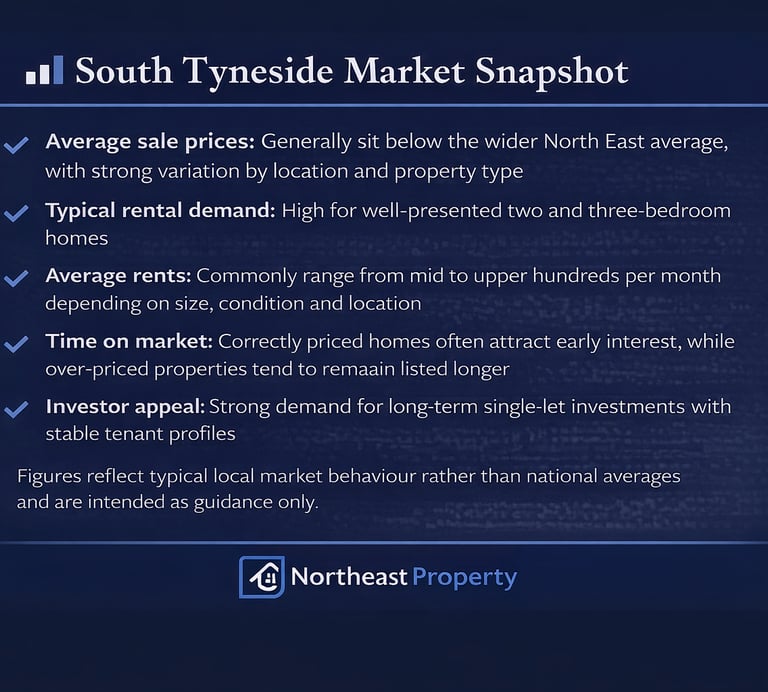
South Tyneside remains one of the more affordable coastal property markets in the North East. Average sale prices typically sit below the regional average, with strong variation depending on location, property type and condition.
Traditional terraced housing in areas such as Jarrow and parts of South Shields often sits at the more accessible end of the market
Semi-detached and family homes in Boldon, Cleadon and Whitburn generally achieve higher price points
Coastal and well-presented properties continue to attract stronger buyer interest and faster sales
In practice, correctly priced homes in good condition are still selling, while properties that are over-priced or poorly presented tend to experience longer time on market.
Our experience locally shows that accurate pricing and realistic expectations remain the biggest factors in achieving a successful sale.
Rental Market & Tenant Demand
The South Tyneside rental market continues to experience strong tenant demand, particularly for well-maintained homes in practical locations.
Typical monthly rents vary by property type and area, but broadly:
Two-bed terraced and smaller family homes remain in high demand
Well-located three-bed houses attract consistent interest from long-term tenants
Demand is strongest near transport links, schools and employment routes
Supply remains limited in many parts of South Tyneside, which has helped support rental values and reduce void periods where properties are priced correctly.
From a landlord perspective, properties that are compliant, well presented and realistically priced tend to let quickly and perform consistently.
Time on Market & Buyer Behaviour
Buyer behaviour in South Tyneside remains price-sensitive. Properties that enter the market at a realistic level typically generate early interest, while those that chase the market often experience longer marketing periods and price reductions.
Homes that benefit from:
Clear presentation
Accurate pricing
Good photography and marketing
…continue to outperform the wider market.
Early engagement is usually a strong indicator of whether a property has been positioned correctly from the outset.
Investor & Landlord Insight
South Tyneside continues to appeal to investors due to its combination of affordability, rental demand and long-term tenant profiles.
Many landlords focus on:
Long-term single-let investments
Stable yields rather than short-term speculation
Areas with consistent demand rather than headline growth
Regulatory changes, compliance costs and mortgage rates mean investors are now far more selective — making proper due diligence and local knowledge more important than ever.
Investors who understand local demand, regulation and realistic rental performance are better placed to achieve sustainable long-term returns.
How We Build Our Market Insights
Our market insights are built using a combination of local transaction data, live rental demand, ongoing buyer and tenant enquiries, and hands-on experience across South Tyneside.
Rather than relying solely on national averages, we focus on what’s actually happening at street and neighbourhood level.
© Northeast Property 2026. Northeast Property is a trading name of Northeast Starlight Property Limited, registered in England and Wales at 334 High Street, Jarrow NE32 3BH (company number 15227296)